Rewrite a brand voice description as a one-page set of rules, word lists and examples that an AI model can follow and a reviewer can check.
Why adjectives are not rules
Most brand voice documents are lists of adjectives: friendly, confident, human, clear. A person who knows the brand can fill in what those words mean. A model cannot. Ask it to be 'friendly but professional' and it produces its own average idea of friendly and professional, which is roughly what every other brand gets from the same request.
A second problem: an adjective cannot be checked. When a reviewer reads a draft and asks whether it is confident enough, two people give two answers. A rule such as 'no hedging words like might, perhaps or arguably in the opening sentence' has one answer.
So the goal is a guide that does two jobs at once. It tells the model what to do in terms it can act on. It tells the reviewer what to check in terms that have a yes or no answer.
Start from real samples, not aspirations
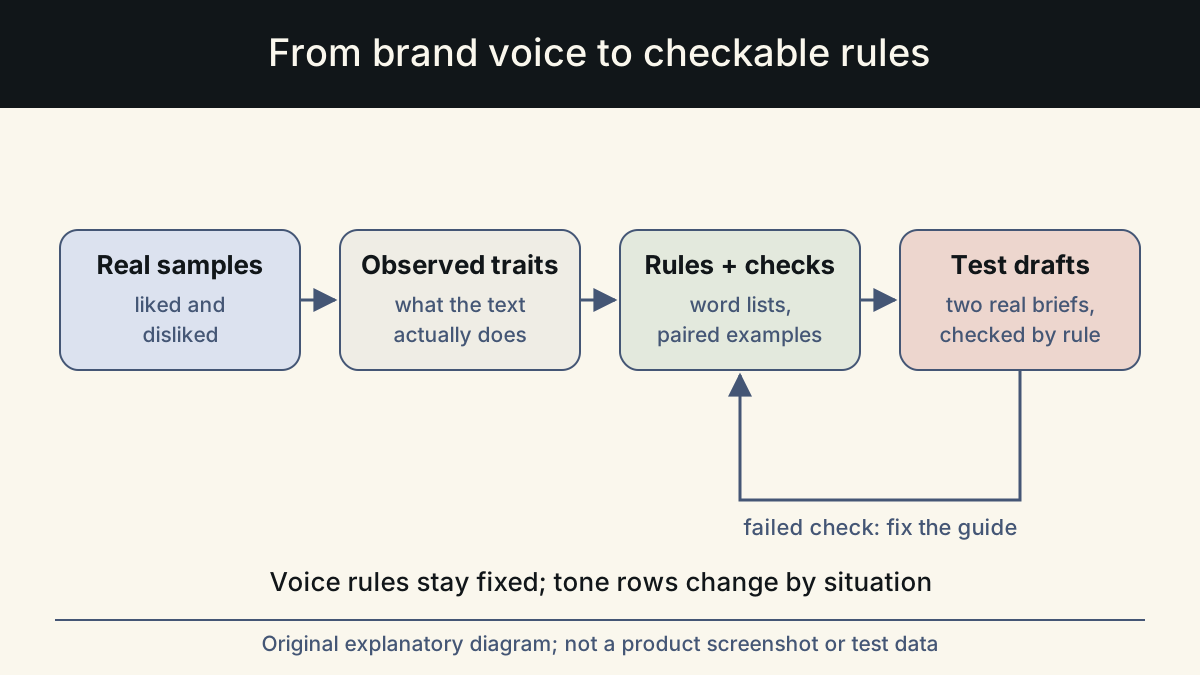
Collect writing the brand already likes. Five to ten pieces is enough: a page that converted well, an email customers replied to, a support answer someone praised. Add two or three pieces the brand dislikes, its own or anyone else's, and note what is wrong with each.
Read the good samples side by side and write down what they actually do, not how they feel. How long are the sentences? Do they address the reader as you? Do they open with the point or with context? Do they use contractions, questions, numbers, jargon? Which words appear again and again, and which never appear?
This gives you traits grounded in evidence. 'Direct' becomes 'every sample opens with the main point in the first sentence'. That observation is already halfway to a rule. Where a sample and an aspiration disagree, mark it as an open decision for the brand owner rather than choosing quietly.
Write the findings as a short table with three columns: what the samples do, how often, and an example sentence. If only one of eight samples uses a question as a headline, that is not a trait. If seven of eight open with a verb, it probably is. This keeps the guide honest about the brand as it writes today, and it gives the brand owner something specific to agree or disagree with instead of a list of adjectives to nod at.
Turn each trait into a rule you can check
For each trait, write one to three rules and the check a reviewer would run. Keep the total to five to eight rules. More than that and neither the model nor the reviewer holds them all at once. The table shows the pattern.
| Trait | Rule for the model | Check for the reviewer |
|---|---|---|
| Direct | Open with the main point. No scene-setting first sentence. | Does sentence one state the point? |
| Plain | Sentences under 25 words. One idea per sentence. | Any sentence over 25 words? |
| Warm | Address the reader as you. Contractions are fine. | Any 'users' or 'customers' where 'you' fits? |
| Confident | No hedges in claims: might, perhaps, arguably. | Search for the hedge words. |
| Honest | No superlatives or comparisons unless on the fact list. | Search for best, only, first, leading. |
Voice stays the same; tone moves with the situation
Mailchimp's content style guide draws a useful line: voice stays consistent, while tone changes with the context and the reader's state of mind. A guide that only describes voice will produce the same register for a launch announcement and an outage notice.
Nielsen Norman Group describes four dimensions of tone: formal or casual, serious or funny, respectful or irreverent, and matter-of-fact or enthusiastic. Use them to write a short tone row for each situation the brand writes in. The voice rules above stay fixed; only the tone settings change.
For example: a product launch might be casual, light, respectful and moderately enthusiastic. An error message might be casual, serious, respectful and matter-of-fact. A reply to a complaint might be slightly more formal, serious, respectful and matter-of-fact. Give the model the voice rules plus the tone row for the job at hand.
Keep the tone rows in the same file as the voice rules, and label each one by situation rather than by mood. A writer, or a model, should be able to find the right row from the brief alone: launch, error, complaint, renewal reminder, job post. If a brief does not match any row, that is a sign the guide needs one more, not that the model should improvise.
Word lists and paired examples
Word lists are the most reliable part of a voice guide, because they are concrete. Keep three short lists: words the brand uses (its own names for things), words it avoids, and replacements, written as 'say this, not that'. The GOV.UK A to Z style guide is a good model of the replacement format; its words-to-avoid entry pairs vague terms with plain alternatives.
Examples do more than descriptions. Prompting guides from model providers, including OpenAI's, recommend giving the model a few input and output examples. For a voice guide, the most useful format is a pair: the same message written off-voice and on-voice, with one line explaining the difference. Two or three pairs teach more than a page of adjectives.
- Why the after version fits: opens with the point, uses you, gives the reader the one thing they need to know, no apology formula.
- Rule it demonstrates: 'Open with the main point' and 'Tell the reader what, if anything, they need to do.'
Test the guide on a real brief before you rely on it
A voice guide is a hypothesis until it has produced some copy. Pick two real briefs of different types, such as a landing section and a support reply. Give the model only the guide and the brief, and generate a draft for each.
Then review each draft against the checks column, not against your feeling. Every failed check means one of three things: the rule is unclear, the rule conflicts with another, or the model needs an example. Fix the guide, not the draft, and run it again. Two rounds usually expose the vague rules.
Finally, ask the brand owner to read the drafts next to the samples. Anything they reject that the guide allowed is a missing rule. Anything the guide forbade that they would have accepted is a rule to loosen.
Keep it short, versioned and in use
Keep the guide to one page that you paste or attach the same way every time. Put a version number and date at the top. When you correct a draft by hand, ask whether the correction belongs in the guide; if it does, add it, so you make each correction once. Retire rules nobody breaks anymore, so the ones that matter stay visible.
Whalory is one way to keep this in one place. It is a writing workspace for professionals who write with AI, where brand voice sits next to task-specific forms and a review step that keeps approved facts and removes invented claims. A plain text file works too, as long as the rules are checkable and the examples are real.
Sources
- Voice and Tone (Mailchimp Content Style Guide)
Distinction between a consistent voice and a tone that shifts with context and the reader's state.
Checked: November 10, 2026
- The Four Dimensions of Tone of Voice (Nielsen Norman Group)
The four tone dimensions used for per-situation tone rows.
Checked: November 10, 2026
- A to Z style guide (GOV.UK content and publishing guidance)
Words-to-avoid entry as a model for replacement word lists.
Checked: November 10, 2026
- Prompt engineering (OpenAI API documentation)
Recommendation to give clear instructions and a few input and output examples.
Checked: November 10, 2026
This article was written and reviewed with AI assistance. The sources above are there for you to check. Weigh the advice against your own situation.
Try this method on your own writing
Spotted a mistake or something unclear? Report it on GitHub. The article name and the section are enough; do not put confidential details in a public report.