Draft a job post with AI from a structured intake, then review it for clarity, fair language and specific, confirmed details.
What a candidate needs from a job post
A job post has one reader who matters: the person deciding whether to apply. They want to know what they would do in a normal week, what they need to already know, what the pay and working pattern are, and what happens after they click apply. Everything else is decoration.
Ask an AI to 'write a job post for a senior data analyst' and you get the decoration. The draft will describe a fast-paced, dynamic environment, ask for a rockstar with excellent communication skills, list twelve requirements copied from the average of the internet, and leave out the salary. It reads like every other post, because in a sense it is every other post.
The fix is the same as for any AI draft: give the model the facts it cannot know, and review the output for the specific risks of the format. For job posts those risks are vagueness and language that discourages people the law protects, or people who could do the job well.
Start from a hiring intake, not a job title
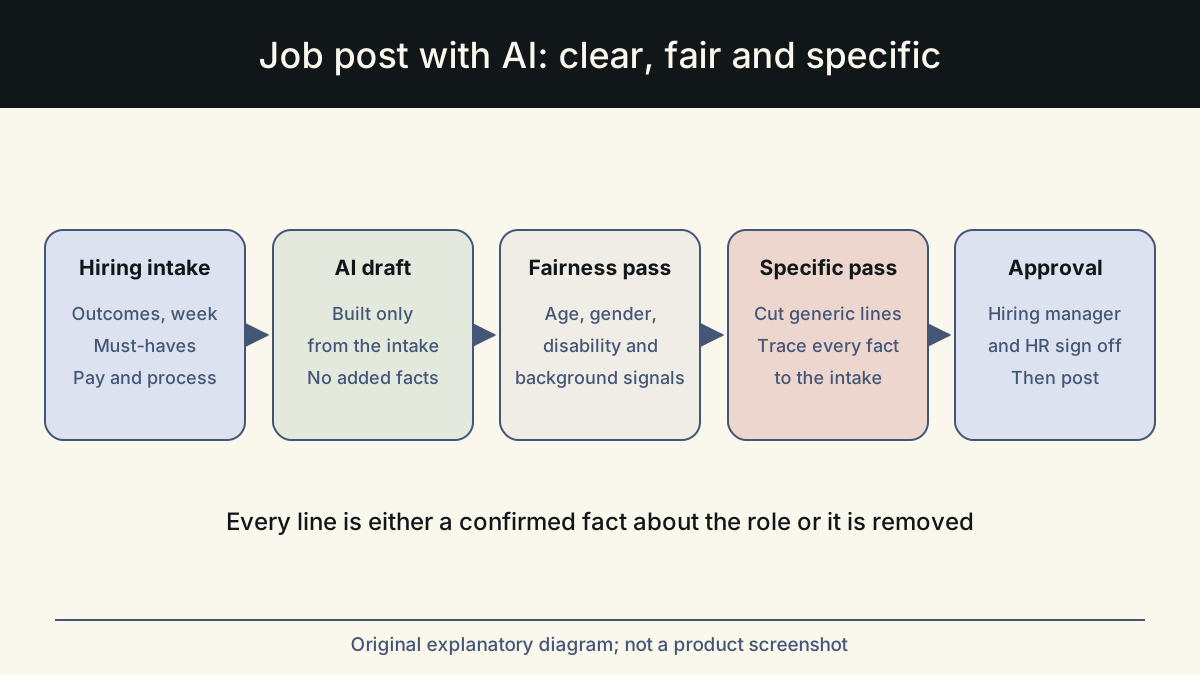
Before drafting, spend fifteen minutes with the hiring manager on a short intake. The intake is the source of truth for the post. The AI turns it into readable prose; it does not add to it.
Separate must-haves from nice-to-haves during the intake, not after the draft. Long requirement lists put off qualified people who do not tick every box, and a model will happily lengthen a list if you let it. Ask the manager which three or four skills someone needs on day one, and which can be learned in the first months.
| Intake field | Why candidates need it | Illustrative answer |
|---|---|---|
| Outcomes in the first 6 months | Shows what the job actually is | Rebuild the weekly sales dashboard; cut manual reporting steps |
| Typical week | Lets people picture the work | Two days on analysis, one on stakeholder requests, two on data quality |
| Must-have skills | Defines the real bar | SQL, one BI tool, explaining results to non-analysts |
| Can be learned | Widens the pool honestly | Our warehouse setup, Python for automation |
| Pay and working pattern | The first thing many people look for | Salary range, hours, hybrid days, location |
| Process | Reduces drop-off and uncertainty | Three stages, about three weeks, one take-home task of up to two hours |
Check the language for fairness
AI drafts pick up phrases that look harmless but signal who is wanted. The US Equal Employment Opportunity Commission states that some job ads are illegal. An ad must not show a preference based on a protected characteristic, or discourage someone from applying because of one. Those characteristics include sex, age (40 or older), disability and national origin. Its own example is an ad seeking 'recent college graduates', which may discourage people over 40.
UK guidance on GOV.UK makes a similar point. Only use phrases like 'recent graduate' or 'highly experienced' when they are genuine requirements of the job. Where you advertise can also cause indirect discrimination. Laws differ by country and state, so treat this section as a review prompt, not legal advice, and check with HR or counsel for your jurisdiction.
Google's developer documentation style guide on inclusive language is a practical reference for wording beyond the legal minimum: avoid ableist idioms, gendered defaults and terms that assume a background. Run the AI draft through these checks as a separate pass, because a model asked to write and to self-censor at once tends to do both badly.
- Age signals: digital native, recent graduate, young team, energetic, a set number of years when skill is what matters.
- Gendered defaults: he or she for the candidate, ninja, rockstar, dominate.
- Disability signals: physical requirements not needed for the work, such as must be able to stand all day for a desk role.
- Background filters: native English speaker instead of the actual language level needed; culture fit with no definition.
- Required degrees for work that does not depend on one.
Replace every generic line with something true
After the fairness pass, read each sentence and ask whether it could appear in any other company's post. If it could, replace it with a detail from the intake or delete it. Phrases like 'competitive salary', 'great culture' and 'exciting opportunity' carry no information, and readers skip them.
Be just as strict about facts. The model may add benefits you do not offer, a team size it guessed, or a remote policy that changed last quarter. Every factual line in the post should trace back to the intake or to an HR document.
Specific does not mean long. A post that states the outcomes, the real requirements, the pay and the process in plain sentences is usually shorter than the generic version, because it drops the filler. If you want the model to help with length, ask it to cut, not to expand.
A review checklist before you post
Have someone other than the writer run this list, ideally the hiring manager plus one person from HR or recruiting. It takes about ten minutes and catches most problems before candidates see them.
- The first paragraph says what the person will do, not how great the company is.
- Must-haves are four or fewer and each is needed on day one.
- Pay range, location, working pattern and contract type are stated.
- The hiring process is described with stages and rough timing.
- No phrase signals a preferred age, sex, disability status, nationality or background.
- Every benefit, policy and number matches the intake or an HR source.
- An accommodation or adjustments contact is included for the application process.
- The post reads clearly aloud in under three minutes.
Turn it into a routine
Save the intake form, the fairness list and the review checklist as a set. For each new role, fill the intake, ask the AI for a draft built only from it, run the two review passes, and get the hiring manager's sign-off. Keep the approved post with its intake so the next opening for a similar role starts from confirmed facts.
Whalory is one way to set this up. It is a writing workspace for professionals who write with AI. It has task-specific forms for roles including recruiting, brand voice settings, and a review step that keeps approved facts and removes invented claims. You can use it in the browser through the Online Studio, which needs no personal AI key. Or install the free Core package as a skill in an assistant such as Claude Code or Gemini CLI. The examples in this article are illustrative, not customer results.
Sources
- Prohibited Employment Policies/Practices (US EEOC)
Used the Job Advertisements section, including its example of an ad seeking recent college graduates.
Checked: November 10, 2026
- Employers: preventing discrimination, recruitment (GOV.UK)
Used the guidance on phrases like recent graduate or highly experienced and on where adverts are placed.
Checked: November 10, 2026
- Write inclusive documentation (Google developer documentation style guide)
Used as a practical reference for inclusive wording beyond legal requirements.
Checked: November 10, 2026
This article was written and reviewed with AI assistance. The sources above are there for you to check. Weigh the advice against your own situation.
Try this method on your own writing
Spotted a mistake or something unclear? Report it on GitHub. The article name and the section are enough; do not put confidential details in a public report.