Set up a fact sheet, drafting rules and a review pass that catch invented claims before AI-written marketing copy goes out.
Why marketing copy invites invented facts
A language model writes the most likely next sentence. It does not check whether that sentence is true. In marketing copy, the most likely next sentence often contains a number, a feature, a customer type or a quote, and the model will supply one whether or not you gave it one. The result reads well, which is the problem: nothing about a made-up detail looks made up.
Marketing copy is especially exposed because it asks for specifics. 'Save time on reports' seems to ask for 'save 3 hours a week'. A list of three features seems to ask for a fourth. A landing page seems to ask for a customer quote. Each is an invitation to invent, because the brief asked for a specific and did not provide one.
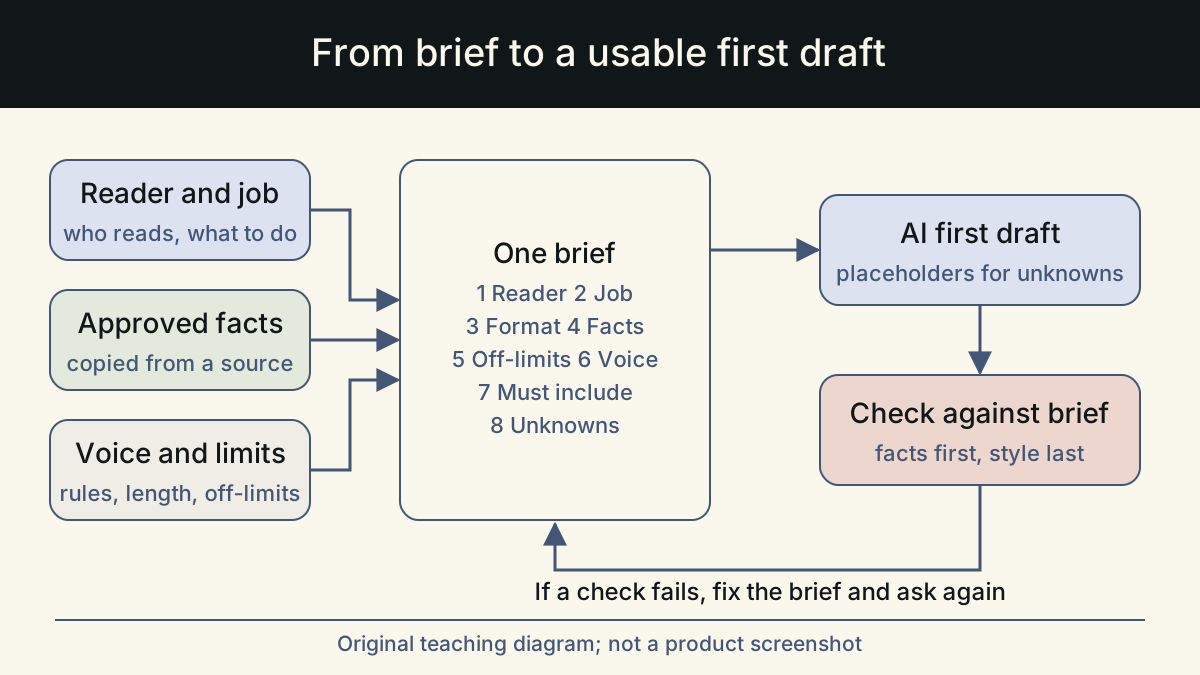
You cannot fix this with one clever instruction. You can reduce it a lot, and catch most of what is left, with a process. The steps below are that process, in the order to run it. Most of the work happens before the model writes a word, because a model that has the facts has much less reason to guess.
Step 1: write the fact sheet before the brief
A fact sheet is a short list of statements you are willing to publish, each with the place it comes from. It is not a creative document. Keep it plain enough that anyone on the team could check a line in a minute.
A small example for a reporting tool might read like this:
- F1. Exports reports as CSV and PDF. Source: help page, checked on the date you checked it.
- F2. The free trial needs no card. Source: pricing page.
- F3. Refunds are available within seven days of a first purchase. Source: terms of service.
- Never say: customer names, testimonials, user counts, revenue, time saved, comparisons with named competitors, 'best', 'number one', any percentage without a source.
Steps 2 and 3: a rule for gaps and a list of suspect categories
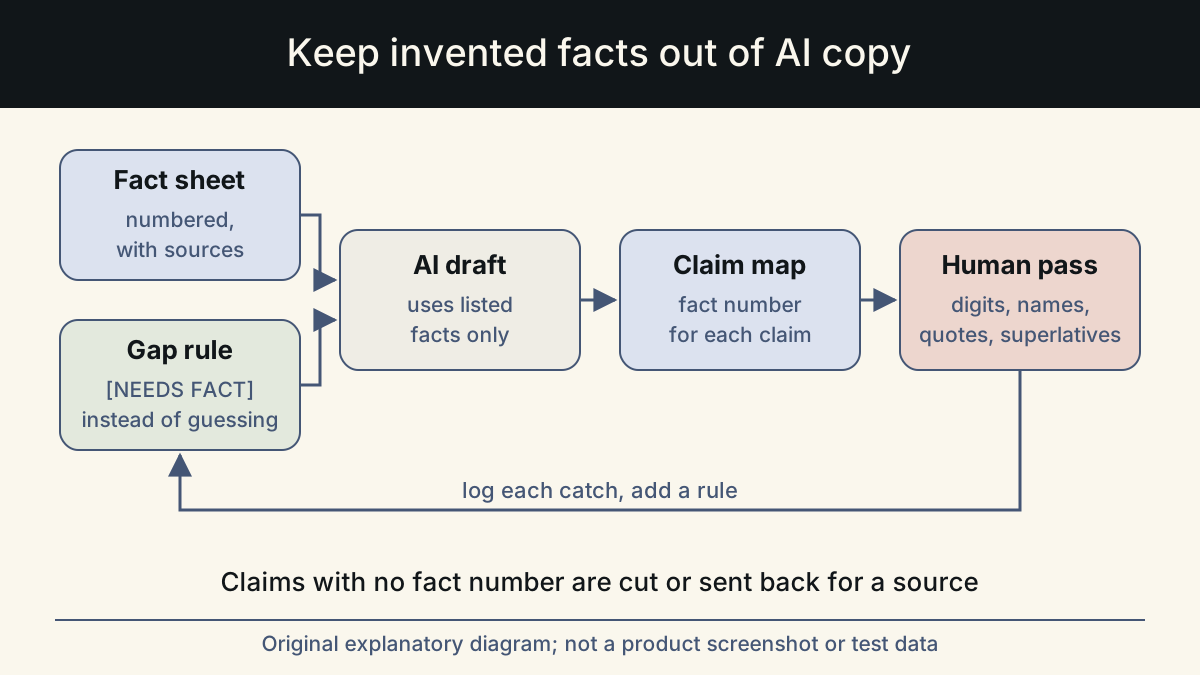
Three habits make the fact sheet work. Write one statement per line and number it, because the numbers matter in step 4. Give every line a source; if you cannot name one, the line does not go on the sheet. Add the 'never say' list at the bottom, because naming the forbidden categories stops the model from helpfully producing them. Keep the sheet as a maintained file, not a prompt you retype, so that when a fact changes you change it in one place.
Most invented facts happen at a gap. The sentence needs a number, you did not give one, so the model picks one. Replace that pressure with an explicit instruction. Use only the numbered facts below. If a sentence would need a fact that is not in the list, write around it or put [NEEDS FACT: what is missing] in its place. Do not estimate, round up or infer. Anthropic's guidance on reducing hallucinations makes a related point: give the model explicit permission to say it does not know, and restrict it to the documents you supply.
The placeholder matters. A visible marker can be found with a search. A plausible guess cannot.
Then name the categories the model may never produce on its own. Each one is a claim a reader could hold you to, so each deserves its own line in the instructions rather than a general request to be accurate:
- Numbers, percentages, prices, amounts of time or money
- Names of people, companies and customers
- Quotes and anything that reads like a review
- Dates and time words such as 'now', 'new', 'latest', 'this year'
- Superlatives and comparisons: best, fastest, first, only, better than
- Guarantees, refund terms and anything with legal weight
Step 4: make the draft show its work, then review it fresh
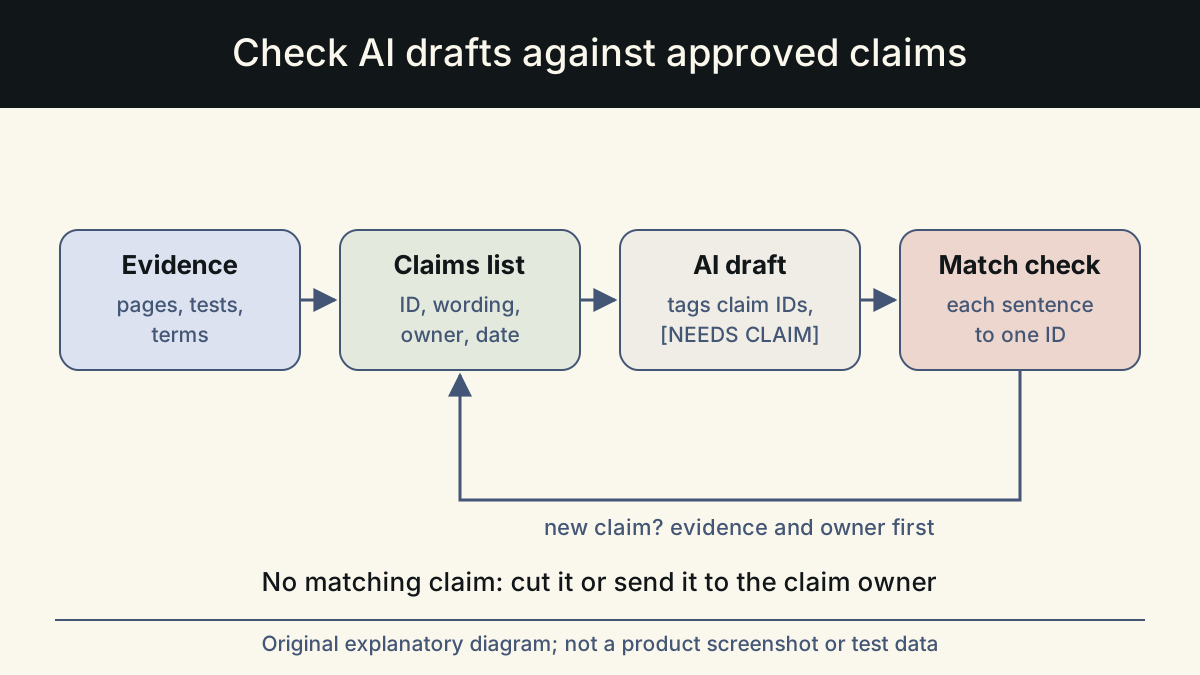
After the draft, ask the model to map it: for every factual statement, give the fact number it relies on, and list any statement that has no matching fact. This turns a vague worry ('is any of this made up?') into a short list. Statements with no fact number are your suspects. Some will be harmless transitions. Some will be exactly what you were afraid of.
Anthropic's documentation describes the same idea for press releases: after drafting, find a supporting quote in the source documents for each claim, and remove any claim that has none. The model's account of itself is not a verdict, though. It points your attention; it does not replace your check.
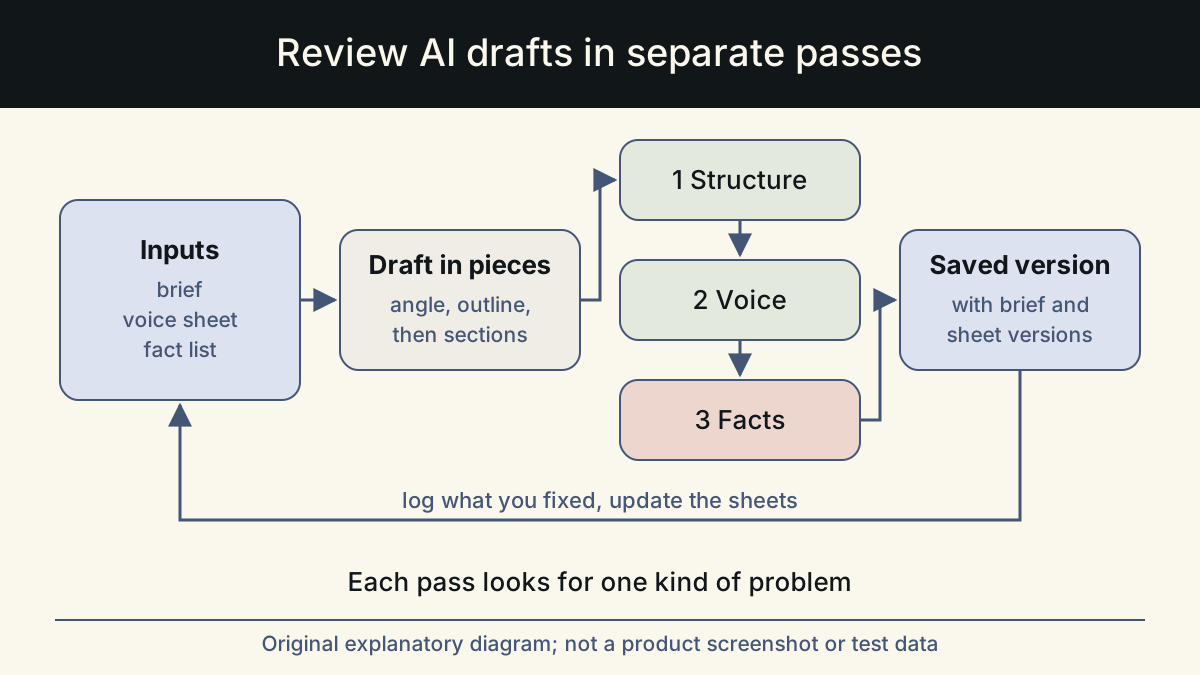
A model reviewing its own draft in the same conversation tends to defend what it just wrote. For the review, open a new session and paste only the fact sheet and the draft. Ask for one thing: list every claim in this text that the fact sheet does not support, and do not rewrite anything. Then you decide what to cut.
Step 5: a human fact pass with a method
Do not just read it through. Generative models predict likely text and cannot tell whether it is true, as Nielsen Norman Group's article on AI hallucinations explains, so the final check has to be yours. Scan for the same categories as step 3, one at a time, and check each hit against the fact sheet.
This takes minutes. For anything that carries risk, such as an ad, a pricing page or a launch announcement, a second person doing the same scan is cheap insurance. In the United States, the FTC expects advertisers to have a reasonable basis for objective claims before an ad runs. A fact sheet with sources is a simple way to show where each claim came from. This is not legal advice, and regulated claims need a qualified reviewer.
| Highlight | Ask | If it fails |
|---|---|---|
| Every digit, percentage and currency sign | Which fact number is this? | Cut it or replace with a sourced figure |
| Every proper noun | Is this name on the sheet? | Remove it or get a source and permission |
| Every quotation mark | Who said this, and may we use it? | Delete the quote |
| first, best, only, leading, trusted, proven | Can we prove this today? | Delete or rewrite as a plain fact |
| now, new, latest, this year | Is it still true on the publish date? | Update or remove the time word |
A worked example
Here is a brief with a gap: write a two-sentence product description for an invoicing tool. Without a fact sheet, the model fills the gap. With a fact sheet that says only 'F1. Creates invoices from a template. F2. Sends reminders for unpaid invoices', plus the gap rule, the draft gets shorter, true, and honest about what is missing.
Finally, keep a log. Each time you catch an invented detail, write one line: what it was and why the model probably produced it. Patterns appear quickly, such as a time-saved figure in every subject line or a fourth feature added to every list of three. Turn each pattern into a line in the suspect categories or the 'never say' list.
Where a tool can help, and where it cannot
You can run all of this with a text file and two chat windows. The order is what matters: facts first, a rule for gaps, a claim map, a fresh review, and a human pass with a method.
If you would rather not rebuild it each time, Whalory is one way to do it. It is a writing workspace for professionals who write with AI, with a review step that keeps approved facts and removes invented claims. Its free Core package installs as a skill in Claude Code, Codex, Cursor, VS Code Copilot or Gemini CLI.
No tool removes the need for a person to read what goes out under your name. The process is worth running with or without one.
Sources
- Reduce hallucinations (Claude documentation)
Techniques used in steps 2 and 4: allowing the model to say it does not know, restricting it to supplied documents, and verifying each claim against a supporting quote.
Checked: November 10, 2026
- AI Hallucinations: What Designers Need to Know (Nielsen Norman Group)
Explanation that generative models predict likely text and cannot verify whether it is true.
Checked: November 10, 2026
- Advertising FAQs: A Guide for Small Business (FTC)
The expectation that advertisers have a reasonable basis, meaning objective evidence, for claims before an ad runs.
Checked: November 10, 2026
- FTC Policy Statement Regarding Advertising Substantiation
Background for the point that objective claims need support before publication.
Checked: November 10, 2026
This article was written and reviewed with AI assistance. The sources above are there for you to check. Weigh the advice against your own situation.
Try this method on your own writing
Spotted a mistake or something unclear? Report it on GitHub. The article name and the section are enough; do not put confidential details in a public report.